


Tese de Doutorado de Jorge Alberto Wagner Filho
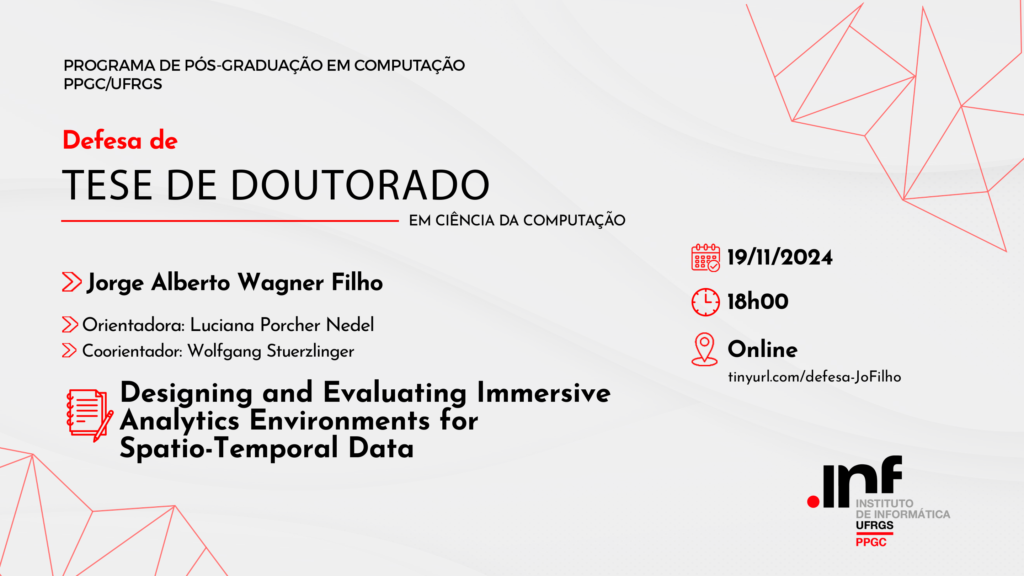
Defesa de Tese de Doutorado
Aluno(a): Jorge Alberto Wagner Filho
Orientador(a): Luciana Porcher Nedel
Coorientador(a): Wolfgang Stuerzlinger
Título: Designing and Evaluating Immersive Analytics Environments for Spatio-Temporal Data
Linha de Pesquisa: Computação Gráfica e Visualização de Dados
Data: 19/11/2024
Hora: 18:00
Local: Esta banca ocorrerá de forma virtual pelo link: https://us06web.zoom.us/my/jorge.wagner.
Banca Examinadora:
-Carla Maria Dal Sasso Freitas (Universidade Federal do Rio Grande do Sul)
-Bruce Thomas (University of South Australia)
-Bernhard Jenny (Monash University)
Presidente da Banca: Luciana Porcher Nedel
Resumo: In this work, I investigate the hypothesis that immersive and stereoscopic Virtual Reality environments, coupled with natural embodied interaction, will better support the visual exploration of three-dimensional spatio-temporal data representations. The research challenge in this thesis is to investigate this hypothesis and identify the most efficient design choices for visualization and interaction in such environments through iterative user evaluations. To this end, I report on the design of an immersive prototype based on the Space-Time Cube visual representation, validated in comparison to a desktop-based baseline. Considering that the design space for user interfaces for Immersive Analytics applications is vast and lacks clear guidelines, I also report on two additional controlled user studies investigating the effects of three relevant factors: exploration mode, frame of reference, and interaction metaphor. My findings indicate that while an immersive Space-Time Cube leads to similar task performance compared to the desktop-based baseline, it results in higher usability scores, higher user preference, and lower perceived mental workload. Moreover, different immersive frames of reference have complementary advantages. While egocentric room-scale exploration significantly further reduces mental workload, exocentric exploration improves performance in some tasks. Combining navigation and manipulation renders tasks easier by reducing perceived workload, temporal demand, and physical effort. Regarding interaction metaphors, I found no significant differences between hands and ray-casting in task performance, workload, or interactivity patterns. Nevertheless, most participants preferred a combined mode and benefited from it by choosing the best alternative for each low-level task. I conclude this work by integrating my findings to propose a new immersive prototype suited to explore la rger real-world datasets of origin-destination data in the urban domain. By reimagining and extending a conventional visualization system, I discuss the concept of immersive extensions and reflect on the potential benefits and limitations introduced by Immersive Analytics.
Palavras-Chave: Immersive analytics. space-time cube. exploration metaphors. interaction metaphors. trajectory visualization. urban data visualization.
PPGC – Programa de Pós-Graduação em Computação
Instituto de Informática – UFRGS
www.inf.ufrgs.br/ppgc