A Model for Simulation of Color Vision Deficiency and
A Color Contrast Enhancement Technique for Dichromats
Instituto de Informática, UFRGS


The thesis was presented in partial fulfillment of the requirements for the degree of Master of Computer Science. The thesis committee was formed by Dr. Rosane Minghim (ICMC USP-SC), Dr. Carla Freitas (II UFRGS), and Dr. Marcelo Walter (II UFRGS). The committee unanimously gave the work an “A” (highest) grade.
Contents
Color vision deficiency (CVD) affects approximately 200 million people worldwide,
compromising the ability of these individuals to effectively perform color and visualization related
tasks. This has a significant impact on their private and professional lives.
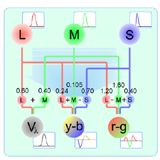
This thesis presents a physiologically-based model for simulating color perception.
Besides modeling normal color vision, it also accounts for the hereditary and most prevalent
cases of color vision deficiency (i.e., protanopia, deuteranopia, protanomaly, and
deuteranomaly), which together account for approximately 99.96% of all CVD cases.
This model is based on the stage theory of human color vision and is derived from data
reported in electrophysiological studies. It is the first model to consistently handle normal
color vision, anomalous trichromacy, and dichromacy in a unified way. The proposed
model was validated through an experimental evaluation involving groups of color vision
deficient individuals and normal color vision ones. This model can provide insights and
feedback on how to improve visualization experiences for individuals with CVD. It also
provides a framework for testing hypotheses about some aspects of the retinal photoreceptors
in color vision deficient individuals.
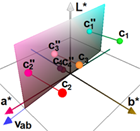
This thesis also presents an automatic image-recoloring technique for enhancing color
contrast for dichromats whose computational cost varies linearly with the number of input
pixels. This approach can be efficiently implemented on GPUs, and for typical image
sizes it is up to two orders of magnitude faster than the current state-of-the-art technique.
Unlike previous approaches, the proposed technique preserves temporal coherence and,
therefore, is suitable for video recoloring. This thesis demonstrates the effectiveness of
the proposed technique by integrating it into a visualization system and showing, for the
first time, real-time high-quality recolored visualizations for dichromats.
Citation
Gustavo M. Machado "A Model for Simulation of Color Vision Deficiency and A Color Contrast Enhancement Technique for Dichromats".
Master’s thesis, UFRGS, Porto Alegre, Brazil (2010).
BibTeX
@MastersThesis{Machado2010msc,
  author  = {Gustavo M. Machado},
  title  = {A Model for Simulation of Color Vision Deficiency and
            A Color Contrast Enhancement Technique for Dichromats},
  school  = {UFRGS},
  address  = {Porto Alegre, Brazil},
  year  = {2010},
}
Keywords
Models of Color Vision,
Color Perception,
Simulation of Color Vision Deficiency,
Recoloring Algorithm,
Color-Contrast Enhancement,
Color Vision Deficiency,
Dichromacy,
Anomalous Trichromacy.
We thank Leandro A. F. Fernandes, Giovane Kuhn, and Francisco Pinto for their help in
conducting this research.
 |
CNPq-Brazil fellowships and grants #
200284/2009-6, 131327/2008-9,
476954/2008-8, 305613/2007-3, and 142627/2007-0. |