


Série de Seminários do INF | Seminários 2025/1
Todos os seminários acontecem às 12:45 e têm duração de aproximadamente 45 minutos, seguido de perguntas. Os seminários podem ser conferidos na íntegra pelo YouTube em @seminariosINF
Human Voice as a Biometric: Can Generative AI Systems Really Emulate It?
Local: Online (transmissão via YouTube, link divulgado próximo à data) (palestra em inglês)
Título: Human Voice as a Biometric: Can Generative AI Systems Really Emulate It?
Palestrante(s): Rita Singh
Gravação: https://www.youtube.com/watch?v=PMTwz7Fcl2A
Resumo: The human voice is unique. A conservative calculation easily shows that the chances of two people having the same voice are less than one in a trillion. This places the human voice alongside DNA and fingerprints as a powerful biometric. In some ways, it is more potent than the latter because it not only carries unique identifying characteristics of the speaker, but also carries information about the speaker at the time of speaking. Over the past decade, Artificial Intelligence systems have become increasingly capable of emulating the human voice. However, many questions arise in this context: Is their capability limited in any way? Is our evaluation thereof biased by our auditory perception? Can generative AI systems really emulate the information embedded in the human voice? Are they on a trajectory to threaten its use as a biometric entity in real life applications? What are the implications of that? In this talk we will ponder all of these issues, briefly discussing how generative AI systems and audio foundation models work, and analyzing their current and future capabilities, extrapolating all the way to quantum-accelerated AI systems.
Mini-bio: Rita Singh is a Research Professor at the Carnegie Mellon University’s School of Computer Science/Language Technologies Institute, with affiliations to three other departments. At CMU, she leads the Center for Voice Intelligence and Security, and co-leads the Machine Learning for Signal Processing and Robust Speech Processing research groups. She has worked on speech and audio processing for over two decades. Since 2014, her work has been focused on developing the science of profiling humans from their voice, a niche area at the intersection of Artificial Intelligence and Voice Forensics. The technology pioneered by her group has led to three world firsts: in 2018, her team created the world’s first voice-based profiling system, demonstrated live at the World Economic Forum; in 2019 her group also created the world’s first instance of human voice — that of the artist Rembrandt — generated based on evidence from facial images; in 2020, her team conceptualized and enabled the first voice-based detection system for Covid-19. She is the author of the book “Profiling Humans from their Voice,” published by Springer-Nature in 2019. She has assisted multiple international agencies in analyzing voice evidence for identifying and profiling potential suspects in crimes under investigation.
The Role of Network Programmability and AI in Distributed and Networking Systems
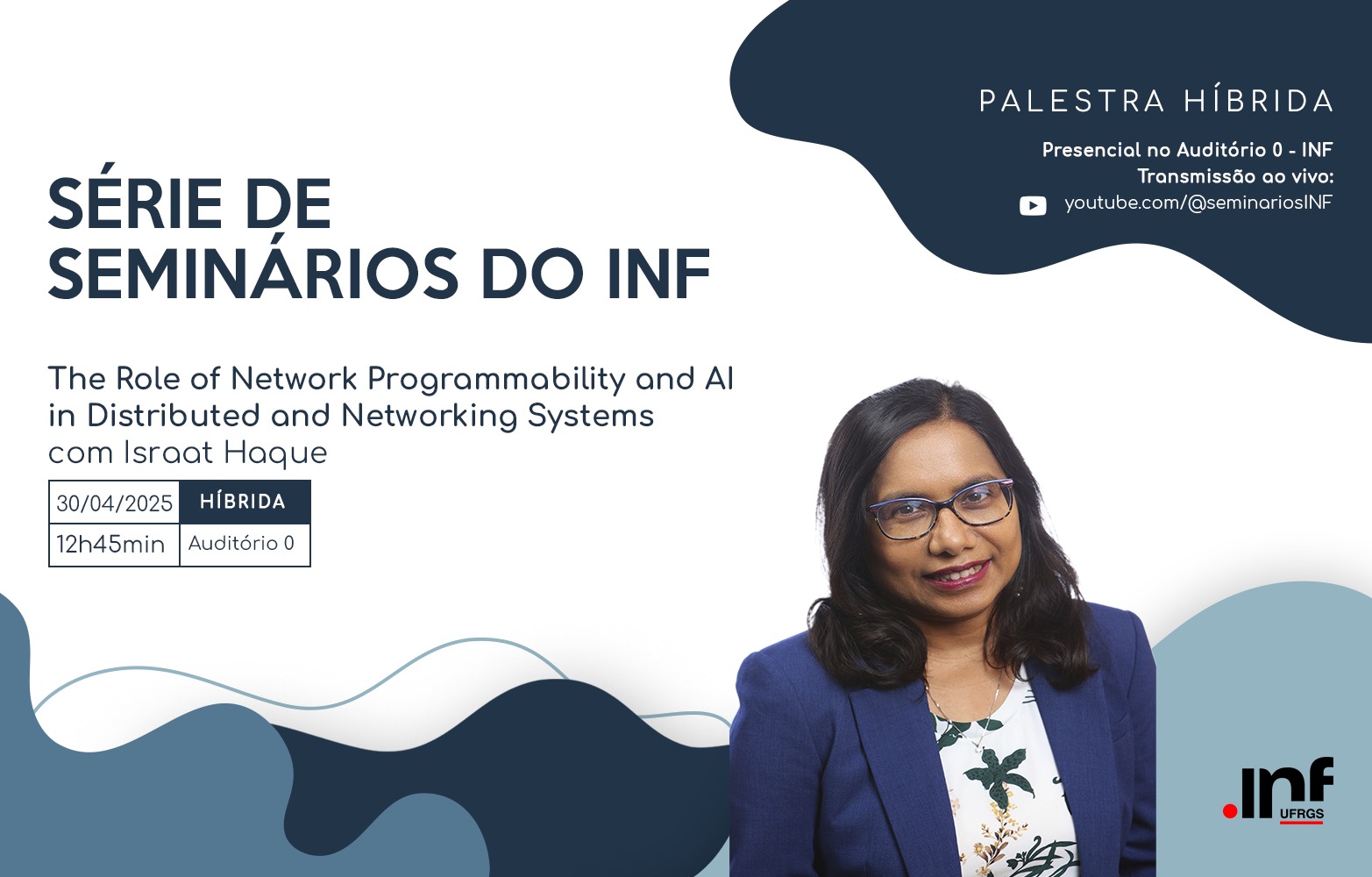
Local: Auditório 0 (palestra em inglês)
Título: The Role of Network Programmability and AI in Distributed and Networking Systems
Palestrante(s): Israat Haque
Gravação: https://www.youtube.com/watch?v=hSWcZXS_rpA
Resumo: Network programmability enables agile configuration, real-time monitoring, and efficient management of network elements, enhancing performance, reliability, and security. At the same time, Artificial Intelligence (AI) offers automated, data-driven orchestration of networks and systems, unlocking new levels of intelligence and adaptability. Together, these two complementary domains are transforming the landscape of distributed systems, particularly in the realms of the Internet of Things (IoT) and telecommunications. This talk will begin by exploring how network programmability can enhance the security and performance of distributed and networking systems. It will then highlight use cases where AI elevates these systems through intelligent automation and decision-making. Finally, the presentation will address key development challenges and emerging opportunities in building AI-driven and big data-enabled systems.
Mini-bio: Dr. Israat Haque is an Associate Professor in the Faculty of Computer Science at Dalhousie University, where she leads the Programmable and Intelligent Networking (PINet) Lab. Her expertise is in distributed and networking systems and security. She leverages network programmability to develop cutting-edge, high-performance, secure, and dependable systems for AI/ML, Big Data, cloud, telecommunication, and IoT systems. She is also interested in applying data-driven approaches to solve practical and relevant problems. Dr. Haque was recognized as an ACM/IEEE N2Women Rising Star in 2021 for her research and leadership contributions. Subsequently, she received Digital Nova Scotia’s Thinking Forward Award 2022 for training the next generation of tech talents. In 2024, she received the Alumni Honour Award from her Alma Mater, University of Alberta.
Projeto Reconecta UFRGS: computadores recondicionados para inclusão digital universitária

Local: Auditório 0
Título: Projeto Reconecta UFRGS: computadores recondicionados para inclusão digital universitária
Palestrante(s): Renato Ribas
Gravação: https://www.youtube.com/watch?v=EunCcRiwaTE
Resumo: O Projeto de Extensão Reconecta UFRGS foi criado para atender estudantes que não possuem condições de adquirir um computador para auxiliar os seus estudos. Computadores doados pela comunidade (pessoas físicas e jurídicas) são recondicionados (consertados, atualizados, configurados) e repassados aos estudantes. Este projeto aborda três temas principais: (1) sustentabilidade ambiental, com o descarte correto de resíduos eletrônicos; (2) consumo responsável, através do exercício do desapego e do reaproveitamento; (3) inclusão digital como ação afirmativa na universidade. Em quase 5 anos de existência já são mais de 400 estudantes diretamente beneficiados. Esta palestra tem por objetivo apresentar, debater, divulgar e refletir sobre um modelo de projeto de extensão universitária de sucesso pela sua simplicidade e seu impacto, e que deveria ser replicado em outras instituições de ensino superior.
Mini-bio: Professor Renato Ribas: professor titular do Instituto de Informática da UFRGS e coordenador do Projeto Reconecta UFRGS.